-
Sacred Journey of the Holy Piprahwa Relics to Bhutan

In a remarkable and unprecedented foreign policy initiative, the Ministry of Culture, in collaboration with the International Buddhist Confederation (IBC) and the National Museum, organized the Holy Piprahwa Relics exposition in Bhutan from 8 to 25 November 2025, witnessing devotees across the world. The exposition represented a significant moment in India’s Buddhist diplomacy, deepening cultural and spiritual ties with Bhutan—one of India’s closest partners in the Himalayan region. Notably, this was the third time in a single year that the Holy Relics of the Buddha were taken abroad for public veneration, marking a departure from the established tradition of organizing only one such exposition annually. This exceptional decision reflected both the growing global demand for Buddhist cultural engagements and India’s willingness to share its sacred heritage to promote peace, dialogue, and interfaith harmony.

The timing of the Holy Relics exposition was particularly meaningful, as it coincided with the Global Peace Prayer Festival 2025 in Thimphu, a major spiritual gathering that draws monastic communities, scholars, and devotees from across the world. Furthermore, the exposition formed an integral part of the nationwide celebrations marking the 70th Birth Anniversary of His Majesty the Fourth Druk Gyalpo, Jigme Singye Wangchuck (King IV), whose visionary leadership and commitment to Gross National Happiness (GNH) have shaped Bhutan’s global identity. The presence of the Holy Relics during these commemorations added profound spiritual significance to the festivities, symbolizing the shared Buddhist heritage and the abiding friendship between India and Bhutan.

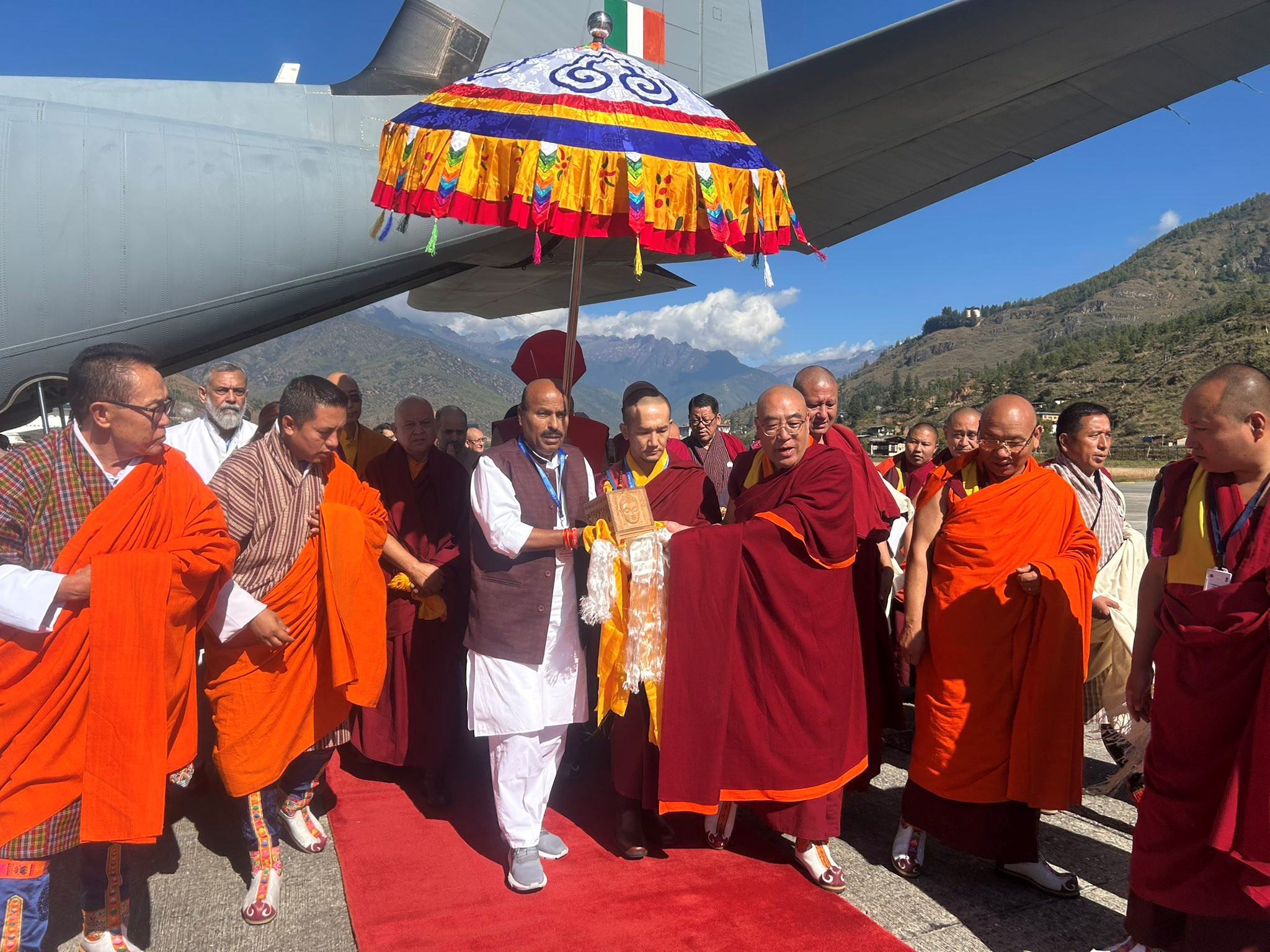
The high-profile Indian delegation entrusted with carrying the Holy Relics to Bhutan was led by Dr. Virendra Kumar, Union Minister of Social Justice and Empowerment, Government of India. His leadership underscored the ceremonial and diplomatic importance of the exposition, reflecting India’s commitment to strengthening cultural diplomacy through Buddhist heritage. Speaking at the event, Dr. Kumar emphasized the universal relevance of the Buddha’s teachings, stating, “We are spreading the message of the Buddha, the path of non-violence that unites the world. India stands firm in its belief in Vasudhaiva Kutumbakam—the world is one family.” His remarks resonated deeply with the audience, capturing the essence of India’s civilizational values and the philosophical underpinnings of its contemporary cultural outreach. By foregrounding the principle of global kinship, Dr. Kumar highlighted how initiatives such as the Holy Relics exposition serve not only devotional purposes but also act as bridges of peace, mutual respect, and shared humanity between nations.

The Holy Relics were received with great reverence at the Kuenrey Hall, Tashichho Dzong by H.E. Tshering Tobgay, the Honourable Prime Minister of Bhutan, members of the Zhung Dratshang, representatives from His Majesty’s Secretariat, and senior government officials. The solemn ceremony included a Chipdrel procession and a Guard of Honour by the armed forces, after which the Holy Relics were enshrined at the Grand Kuenrey for public veneration. Honouring the sacred significance of the occasion, Shri Abhijit Halder, Director General of the IBC observed that the timing of the exposition could not have been more meaningful. In addition to this, Shri Sandeep Arya, Indian Ambassador to Bhutan highlighted the deep appreciation expressed across Bhutan for the sacred Relics. Furthermore, H.E. Mr. Tshering Tobgay remarked that the Global Peace Festival is the collaborative efforts of Bhutan and India.

On 11th November 2025, Shri Narendra Modi, Honourable Prime Minister of India, attended the Global Peace Prayer Festival as the Guest of Honour and commemorate King IV on his 70th birth anniversary, along with His Majesty Jigme Kesar Namgyal Wangchuck (King V) and the Royal Family of Bhutan and paid homage to the Holy Relics of Lord Buddha. He said the prayers of 140 crore Indians are a vital part of the festival and praised Bhutan’s GNH, affirming that nation-building goes beyond GDP.


Alongside the Holy Piprahwa Relics Exposition, the IBC organized three exhibitions at Tashichho Dzong. The first exhibition ‘Guru Padmasambhava – Sacred Pilgrimage Sites in India’, highlighted the revered master who brought the Vajrayana tradition to the Himalayas and showcased key Indian sites linked to his life and legacy. The second one on ‘Sacred Legacy of the Shakyas’, traced the journey of the Holy Relics from ancient Kapilavastu to their rediscovery at Piprahwa, featuring the stone coffer, ornate reliquaries and jewels. It also presented Holy Relics expositions in Mongolia (2022), Thailand (2024), and Kalmykia (2025), along with the 2025 repatriation of the Piprahwa Jewels to India. The third exhibition ‘Life and Teachings of the Buddha’, offered insights on the Eight Great Places of Buddhist pilgrimage and the core principles of the Dhamma.

The exposition witnessed an overwhelming response of more than one lakh devotees in veneration. Following the large public demand, the initial one-week relic exposition in Bhutan was extended further for 7 days, till the 25 November, 2025. The delegation accompanying the Holy Relics back to India was led by Shri Kiren Rijiju, Union Minister of Parliamentary Affairs, Govt. of India.

With great interest, His Majesty Jigme Singye Wangchuck (King IV) and Her Majesty, along with other members of the royal family, learnt about the first two exhibitions, which was presented by Shri Abhijit Halder, Director General IBC and senior IBC officials respectively. The Embassy of India subsequently transformed the exhibition on Guru Padmasambhava into a booklet, which was released by Hon’ble Prime Minister Shri Narendra Modi during his visit and subsequently presented by Shri Rijiju to Mr. Tobgay.

In his words, the exposition was significant as it was taken during the time of World Peace Prayer. The people and the Government of Bhutan are extremely grateful to the Government of India for facilitating this. It shows that India and Bhutan enjoy a unique and a special relationship. Among other things, the bilateral exchange reflected the depth of India–Bhutan friendship. As Shri Rijiju participated in the farewell ceremonies, the event underscored India’s soft power diplomacy, fostering goodwill that transcended borders and politics. With thousands of devotees having queued in Thimphu’s cold weather, the relics’ return marked not an end but a reaffirmation of enduring fraternity, promising future collaborations in preserving this luminous legacy.

The Holy Relics Exposition reaffirmed the Buddha’s universal message of compassion, bringing people together in shared devotion.